|
||
6. Palmate-shaped cohenite crystals |
| Listing of Structures |
| Back...Next |
Meteorite - Santa Rosa, IC Iron. |
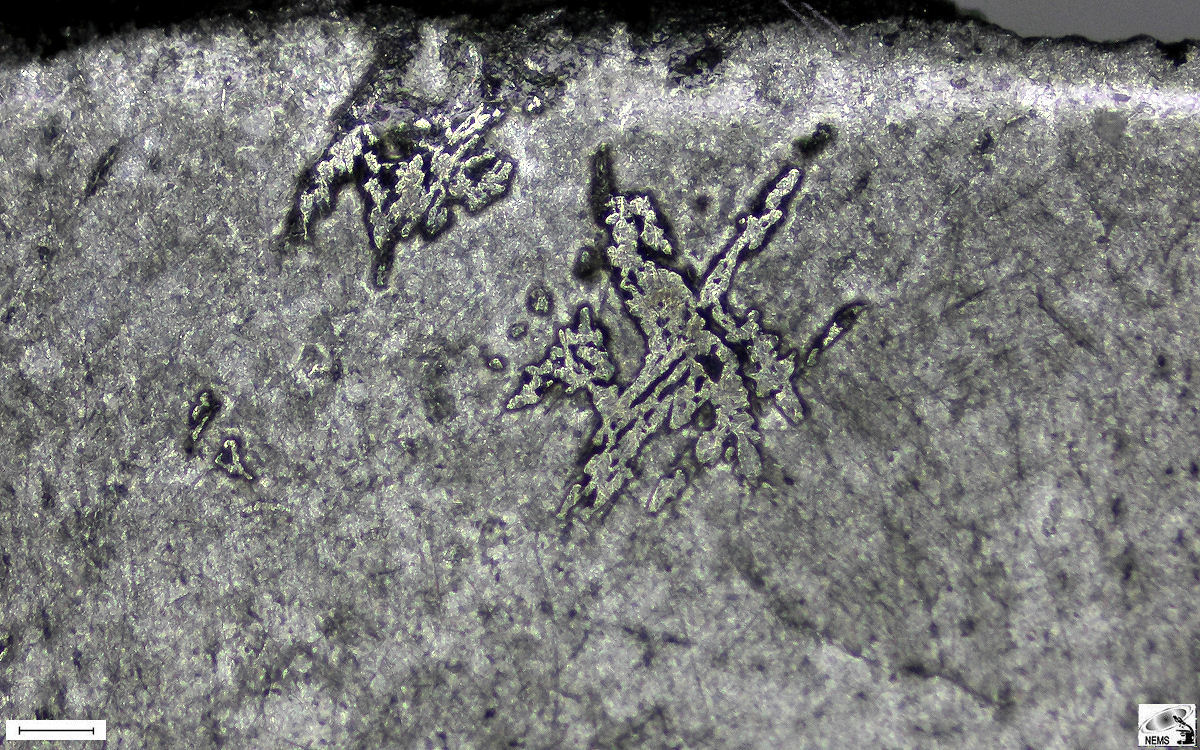 |
| Figure 1. Scale bar 200 µm. |
| Meteorite - Santa Rosa. |
| Classification - Iron, IAB-Mg, 6.11% Ni, 0.14% P |
| Palmate-shaped cohenite structures - Secondary. |
Palmate-shaped Cohenite Crystals in the Santa Rosa Iron Meteorite The Santa Rosa iron meteorite (IC group), recovered near Tunja, Boyacá, Colombia, in 1810, presents a distinctive mineralogical and structural profile that complicates straightforward petrogenetic modeling. As a polycrystalline iron, it features decomposed cohenite ((FeNiCo)3C) and graphite, along with evidence of cosmic reheating manifested in recrystallized kamacite, distorted Neumann bands (shock-induced deformation twins), and the absence of a well-developed Widmanstätten pattern. Chemically and structurally, it is closely related only to the Chihuahua City meteorite among known iron meteorites. Detailed petrographic examination reveals prominent palmate (hand- or fan-shaped) cohenite crystals, often exhibiting a skeletal or dendritic morphology. These structures, ranging from approximately 0.5 to 2.0 mm in size, are uncommon in iron meteorites and contribute to the meteorite’s complex texture. The formation history inferred from prior studies involves multiple stages. At high temperatures, the precursor metal likely consisted of a polycrystalline aggregate of austenite (γ-FeNi) grains, as evidenced by abundant grain boundaries and twinning. Upon cooling, kamacite (α-FeNi) nucleated from these grains, while residual taenite (γ-FeNi) became progressively enriched in carbon via solid-state diffusion. This carbon supersaturation promoted the breakdown of taenite into intricate intergrowths of cohenite, taenite, kamacite, and schreibersite ((FeNi)3P), yielding the characteristic palmate morphologies. Subsequent shock events further modified these assemblages, producing troilite (FeS) melts and additional decomposition of cohenite into kamacite and graphite—a process favored by the long-term instability of cohenite under low-pressure conditions. |
| |
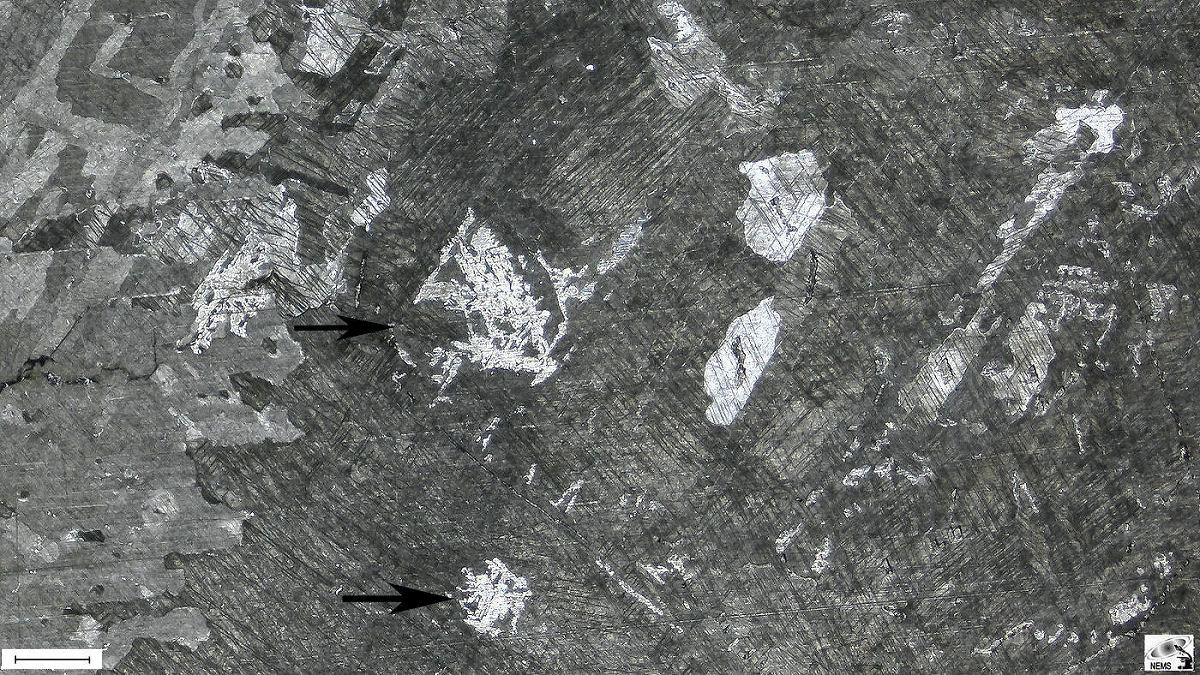
| Figure 2. Scale bar 1 mm. |
| Palmate-shaped cohenite structures. |
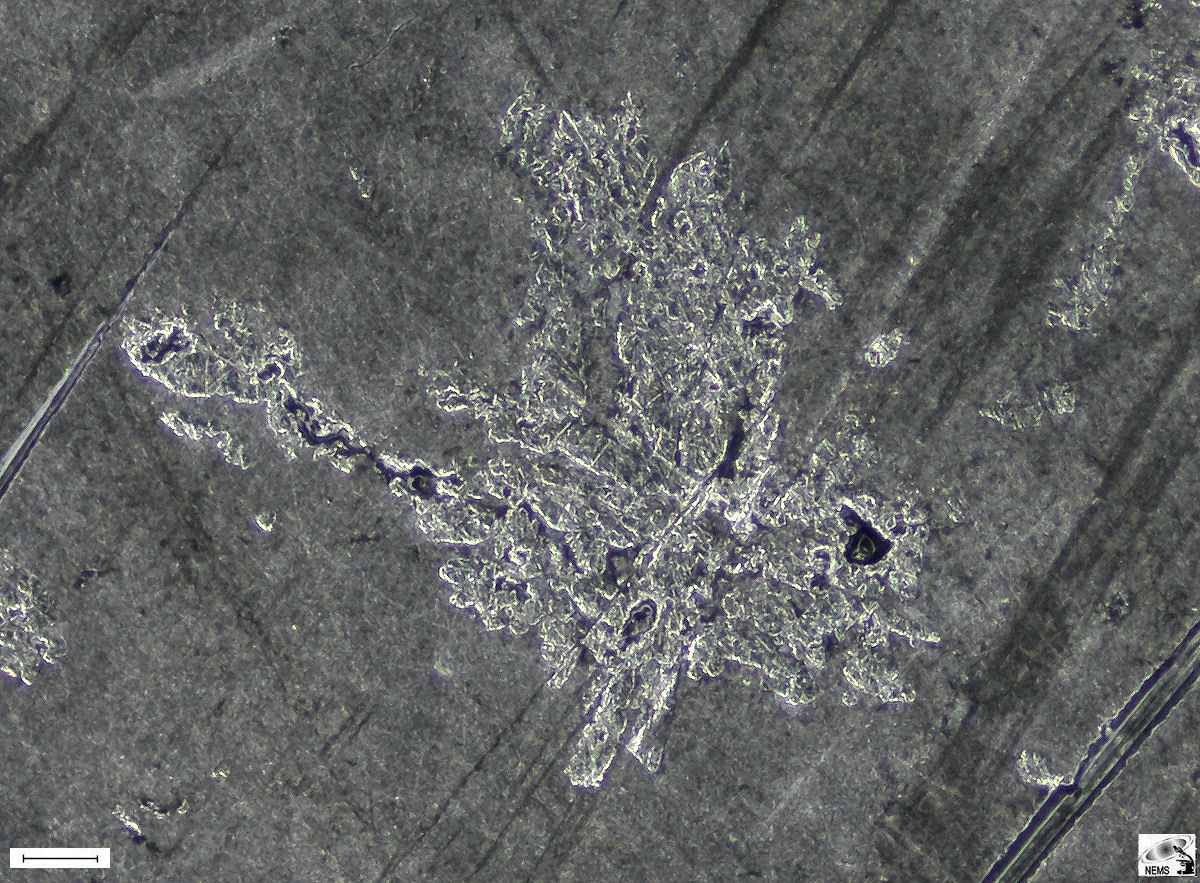
| Figure 3. Scale bar 150 µm. |
| Palmate-shaped cohenite structure. |
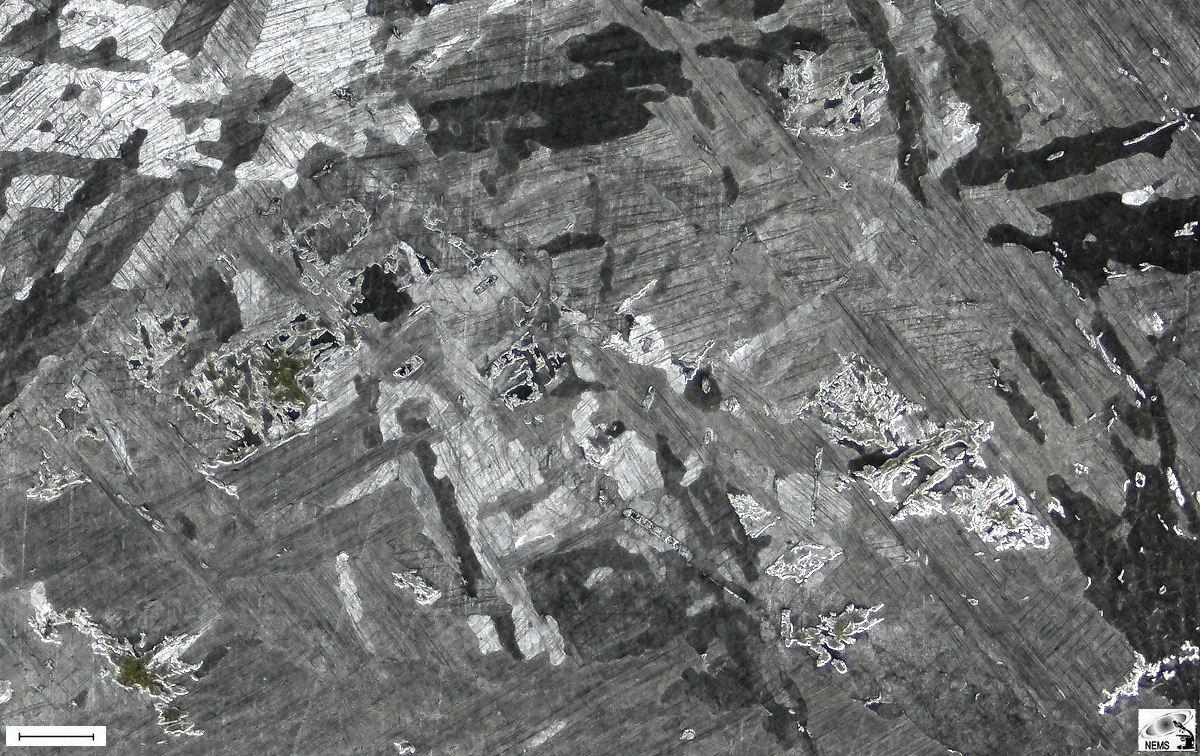
| Figure 4. Scale bar 300 µm. |
| Palmate-shaped cohenite structures. |
| Note, Buchwald, 1975, "Handbook of Iron Meteorites"
addresses the cohenite structures in Santa Rosa in detail.
References • Buchwald, V. F. (1975). Handbook of Iron Meteorites. University of California Press. (Primary reference for structures, including Santa Rosa and cohenite descriptions.) • Buchwald, V. F. (1977). The mineralogy of iron meteorites. Philosophical Transactions of the Royal Society A, 286(1336), 453–491. • Scott, E. R. D. (1977). Composition, mineralogy and origin of group IC iron meteorites. Earth and Planetary Science Letters, 37(2), 273–284. • Tornabene, H. A., et al. (2023). Genetics, age, and crystallization history of group IC iron meteorites. Geochimica et Cosmochimica Acta, 288, 36–50. • Meteoritical Bulletin Database entry for Santa Rosa (LPI). |
| Listing of Structures |